A New Era for Smart Homes
Google is taking a bold step toward making smart homes truly intelligent. The company has officially introduced its Gemini-powered Nest devices, combining its most advanced artificial intelligence model with everyday home technology. The move marks a major shift in how we interact with our living spaces — from passive assistants that follow commands to proactive systems that understand context and act on their own.
The idea is simple: make homes not just connected, but thinking. Gemini, Google’s large language and reasoning model, now powers new Nest Cams, Doorbells, and smart displays, turning them into devices that can predict, adapt, and respond more naturally.
What Is Gemini and Why It Matters
Gemini is Google’s latest AI model, built to understand language, vision, and reasoning together. It’s the same technology behind the Gemini chatbot (formerly Bard), but now it’s finding a home inside physical devices.
Unlike previous assistants, Gemini doesn’t just react to voice commands — it can analyze patterns, interpret scenes, and make useful suggestions.
For example, instead of just showing you who’s at the door, your Gemini Doorbell might say:
“Your package from Amazon was just dropped off. It looks like it’s starting to rain — do you want me to move it under cover with your delivery robot?”
That’s the kind of integration Google is aiming for — combining AI reasoning with smart home automation.
Meet the New Devices
The new generation of Nest devices includes:
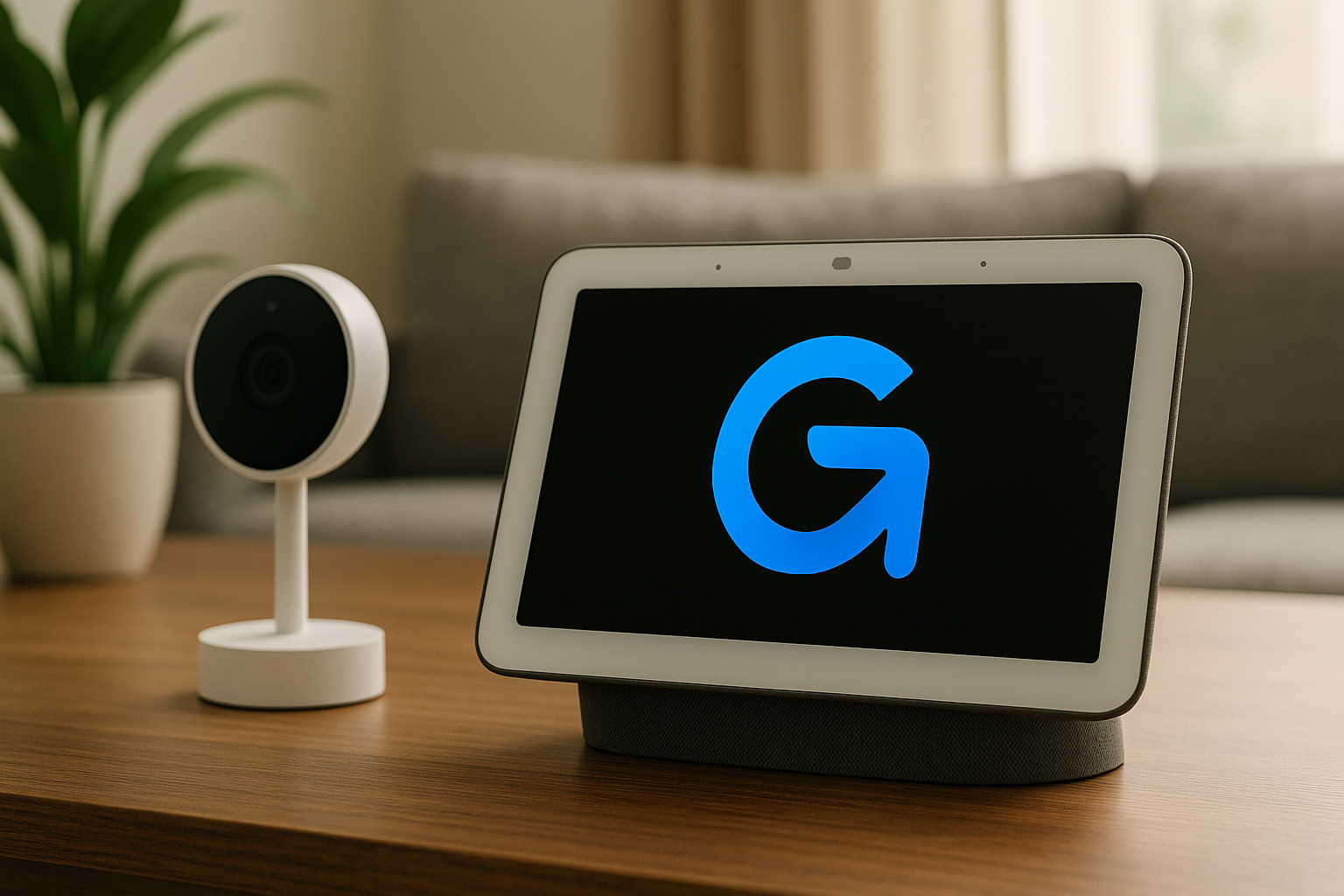
- Nest Cam (Indoor/Outdoor, 2K HDR) – Now featuring Gemini-powered object recognition. It can distinguish between family members, pets, and strangers, and alert you based on context, not just motion.
- Nest Doorbell 2K HDR – With smarter voice recognition, real-time package detection, and integration with Gemini routines.
- Nest Hub Gemini Edition – Google’s smart display now doubles as a home AI assistant, capable of complex conversations and personalized suggestions.
Each device connects to the Google Home ecosystem, allowing routines to run automatically. For example, when your camera detects that you’ve left home, Gemini can lower the thermostat, lock the doors, and send you a summary of home activity — all without needing a command.
Privacy and Data: Google’s Balancing Act
Of course, whenever AI becomes more “aware,” concerns about privacy follow. Google says Gemini devices process most sensitive data locally, meaning your video feeds or conversations don’t leave the device unless you explicitly allow cloud processing.
End-to-end encryption is enabled by default for camera feeds, and users can review or delete stored footage directly through the Google Home app.
Still, experts urge caution. “Local processing reduces risk, but any always-on AI brings privacy trade-offs,” notes cybersecurity researcher Emily Chan. “The key will be transparency — users must know when data is being analyzed and for what purpose.”
Google has promised detailed transparency reports and device settings that clearly show when AI features are active. It’s also introducing a “privacy light” indicator on all Gemini-powered devices, similar to what Nest already uses for microphones and cameras.
AI That Understands Context
One of Gemini’s biggest upgrades over past models is contextual understanding. Traditional smart assistants could follow simple commands like “turn on the lights”, but Gemini can go much further.
Imagine saying:
“I’m going to bed early tonight.”
Instead of asking what you mean, Gemini might:
- Dim the lights in your room,
- Lower the thermostat,
- Arm your security system, and
- Set your alarm 30 minutes earlier.
It can even adjust those actions over time, learning from your routines. If you consistently watch Netflix before sleeping, Gemini might ask, “Do you want to start your usual show before I turn off the lights?”
This kind of adaptive behavior is what Google calls “ambient intelligence” — a system that fades into the background while quietly managing your comfort and security.
How It Compares to Amazon and Apple
Google isn’t alone in the smart home race. Amazon recently launched Alexa+, a generative AI version of its voice assistant, while Apple continues to focus on privacy and ecosystem stability with HomeKit.
Where Google stands out is in its AI integration depth. Gemini’s multimodal capabilities (understanding text, image, and video together) give it an advantage. For instance, if your security camera spots movement, Gemini can analyze the footage, determine that it’s just your dog, and avoid sending a false alarm — something Alexa and Siri still struggle to do.
In short, Google is betting that smarter AI = simpler life.
Challenges Ahead
The rollout won’t be without hurdles. Early testers have pointed out that Gemini’s conversational tone can sometimes feel too “human,” leading to awkward interactions. Others worry about compatibility with older Nest devices and how often AI updates will arrive.
There’s also the issue of energy use — always-on AI models require more power than traditional voice assistants. Google claims efficiency improvements of up to 35% compared to previous Nest generations, but real-world testing will show whether that holds true.
Another challenge is trust. Consumers have seen tech companies promise “smart” ecosystems before — many ended up fragmented, buggy, or abandoned. Google insists that Gemini is here to stay, backed by long-term updates and cross-device support.
The Bigger Picture: A Smarter, Simpler Future
Beyond the gadgets, this launch signals a turning point for Google’s strategy. Gemini isn’t just a voice assistant — it’s an intelligent layer that connects your phone, your car, your home, and even your workspace.
Over time, you might see:
- Gemini in Android Auto, predicting your route based on calendar events,
- Gemini in Gmail, summarizing messages while you cook dinner,
- Gemini in Nest, adjusting your lighting and music based on mood or time of day.
The goal is clear: to make AI a natural extension of your environment, not just another app or device.
Google’s Gemini-powered smart home push is ambitious, bold, and perhaps a bit risky. But if it works as promised, it could redefine what “smart” means in smart homes. Instead of devices that follow orders, we might finally get homes that understand us.
For now, the new Nest lineup sets the stage — and how users respond will shape the next decade of AI at home.