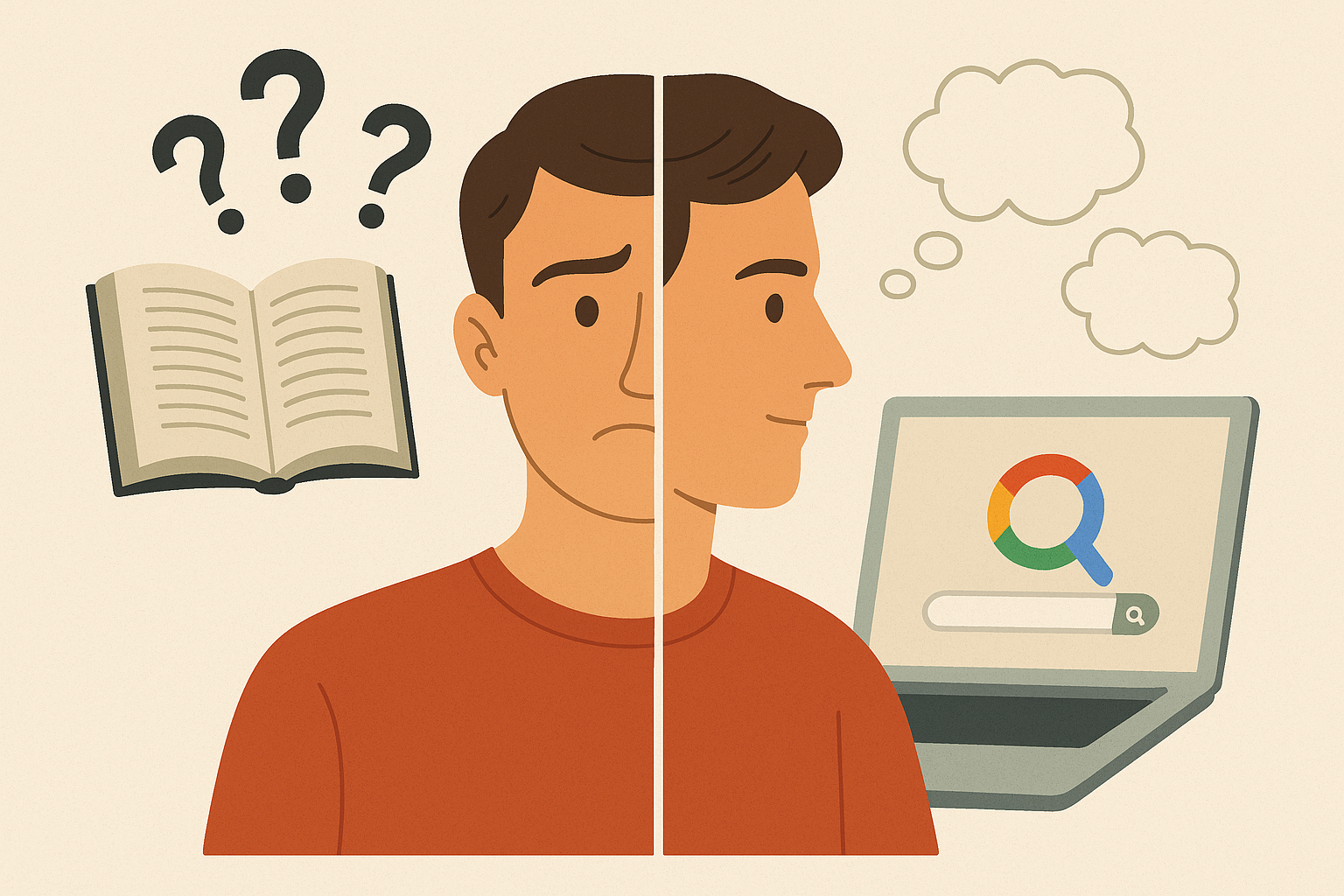
Let’s face it. Google has become our second brain. You forget who played the lead in that old movie? Google. Need to know how to fix a leaking faucet? Google. Curious about whether penguins have knees? Yes, people have searched that too.
But here’s the big question: is this constant reliance on search engines making us dumber? Or are we just evolving into a new kind of smart?
The Case for “Yes, It’s Making Us Stupid”
We’ve all been there: you open your laptop to search for something simple—say, “quick pasta recipe.” Ten minutes later, you’re watching a video about ancient Roman gladiators and wondering how the internet hijacked your evening.
Google is designed for speed and snippets. You don’t need to read a whole book about nutrition when you can skim the first paragraph of a blog post. The downside? Our attention spans shrink. We jump from tab to tab, headline to headline, without sticking around long enough to think deeply.
There’s also the memory issue. Why remember facts when you can “Google it” in seconds? Psychologists call this the “Google Effect”—we offload memory onto technology. It’s convenient, sure. But it raises the fear that we’re losing the ability to hold knowledge in our own heads.
And honestly, when was the last time you remembered a phone number that wasn’t your own?
The Case for “Actually, It’s Making Us Smarter”
Before we write Google off as the villain, let’s be fair. We’ve always outsourced memory. Ancient Greeks worried that writing things down would ruin memory. People in the Middle Ages panicked that the printing press would flood society with too much information. And now? Books are the backbone of knowledge.
Google is just the next step. Instead of memorizing every detail, we learn where to find it. That’s not stupidity—that’s efficiency. It frees up brain space for creativity, problem-solving, and bigger-picture thinking.
And let’s not forget: Google makes knowledge democratic. A kid in a small village with a smartphone has access to the same information as a student at a top university. That’s powerful. We might not remember every detail we read, but we can make connections faster, learn new skills on the fly, and adapt in ways people couldn’t imagine a century ago.
The Attention Span Problem
Now, about that shrinking attention span. Is it really shrinking, or are we just adapting to a different style of reading? Instead of long, deep dives into text, we skim, scan, and pick out key points. It’s like hunting for treasure in a sea of words.
Yes, this makes it harder to read a dense novel without checking your phone every few minutes. But it also means we’re better at filtering noise, spotting patterns, and juggling multiple streams of information. You can call it distraction—or you can call it a new literacy for the digital age.
When Google Replaces Thinking
Of course, there’s a danger when we confuse looking something up with actually understanding it. Searching “symptoms of the flu” doesn’t make you a doctor. Googling “how to start a business” doesn’t mean you’ll be the next Jeff Bezos.
Knowledge isn’t just about having facts—it’s about making sense of them. That requires reflection, context, and sometimes a bit of boredom. And boredom is in short supply when Google offers a quick dopamine hit every time you type in a question.
Smarter, But Different
So maybe the real answer is this: Google isn’t making us stupid or smart. It’s making us different.
We may not memorize as much, but we can access more information than any previous generation. We may skim more, but we also connect dots across disciplines faster. We may forget a detail today, but we know we can summon it back tomorrow with a few keystrokes.
It’s a trade-off. We lose depth but gain breadth. We lose some patience but gain speed.
How to Use Google Without Losing Your Mind
If you’re worried about your brain turning to mush, here are a few simple strategies:
- Read long-form content. Balance quick searches with deeper reads—books, essays, even long articles.
- Practice recall. Instead of googling instantly, try to remember first. Give your brain a workout.
- Go offline. At least for a bit. Think, reflect, or just let your mind wander without a search bar ready to help.
- Use Google as a tool, not a crutch. It’s there to assist you, not replace your thinking.
So, is Google making us stupid? Not really. It’s making us human in a new way—flawed, distracted, but incredibly resourceful. We may not know everything, but we know how to find it. And that’s its own kind of intelligence.
The challenge isn’t to stop using Google. The challenge is to use it wisely. To know when to search, when to think, and when to just sit with a question for a while. Because sometimes, the smartest answers come when you step away from the search bar.